By Brian Fuller, Creative Director
Yes! The expenses associated with hosting your website are real. Paying for software licenses and security monitoring is expected. Take a look at typical ongoing website costs for a small to midsize organization: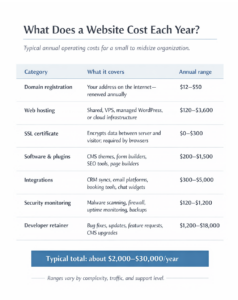 All in, depending on complexity, traffic, and support level, that’s somewhere between $2,000 and $30,000 annually. That’s a known, controllable number you can see and plan for.
What you usually can’t see are the expenses that don’t come with invoices, the ones beyond keeping the links working and the pages loading. Hidden website costs are what you pay when a visitor, someone with intent and money but limited patience, decides to close the tab. Here are a few of the likely culprits:
Slow Load Times
PATIENCE THRESHOLD: ~3 SECONDS
Google has established that as page load time stretches past 3 seconds, the probability of a visitor bouncing increases dramatically, approaching 100% at 10 seconds compared to a 1-second load. If your site is running bloated images, unoptimized scripts, or cheap shared hosting that buckles under moderate traffic, you are not just offering a bad experience. You are paying for advertising, social media, and SEO that send people to a door that doesn’t open fast enough.
Poor Mobile Experience
MOBILE SHARE OF WEB TRAFFIC: 60–65% GLOBALLY
Almost two-thirds of all web traffic happens via mobile. If your site wasn’t designed for mobile, you aren’t just annoying a subset of visitors, you are turning away the majority. Tiny tap targets, text that requires zooming, navigation menus that collapse into chaos, forms that are miserable to complete on a touchscreen—these are conversion killers invisible to whomever approved the site using only their laptop.
Confusing Navigation and Weak Calls to Action
THE CLARITY PROBLEM
A visitor who can’t tell what you want them to do next will not try to figure it out on their own. They’ll leave. Navigation that buries key pages, homepage copy that explains the company’s founding story before it explains what the company actually does, and CTAs that say “learn more” when they should say “get a quote” or “book a call” or “start your free trial” are friction points that kill conversion. Clarity converts. Ambiguity doesn’t.
Broken or Complicated Checkout Flows
AVERAGE CART ABANDONMENT RATE: ~70%
The checkout or inquiry process is where intent meets execution, and it’s where most sites quietly fail. Forced account creation, too many required fields, unclear error messages, dated payment options, no guest checkout, no progress indicator—any one of these can cause someone who was ready to spend money to change their mind. The Baymard Institute, an independent web UX research institute, has tracked cart abandonment for years, and the data, as the stat in the subhead above affirms, is sobering. It is also fixable.
Missing Trust Signals
THE CREDIBILITY GAP
For a first-time visitor, your website is a stranger asking for their credit card number, their email address, or their business. The threshold for trust is high, and the signals that build it are specific: real customer reviews and testimonials, security badges near payment fields, clear and accessible privacy and return policies, visible contact information, staff bios and photos that confirm there are humans involved. Without these, even excellent businesses lose conversions to competitors whose sites simply look more established and trustworthy regardless of which product or service is better.
Some Honest Math
If your site receives 10,000 visitors a month and converts at 1%, that’s 100 customers. If that conversion rate were 2.5% (not an unrealistic improvement with focused UX and performance work), that’s 250 customers. The traffic is the same. The marketing spend is the same. The hosting bill is the same. The only thing that changed is what happens when people arrive.
The cost of fixing these things is almost always a fraction of the lost revenue they silently cost. A website performance optimization audit, a mobile UX review, and a copywriter who understands conversion are not glamorous line items, but they are high-return investments any organization can make in its digital presence. Knowing that, it might be time to find out what’s happening between click and conversion on your website, and what it would be worth to fix it.

